

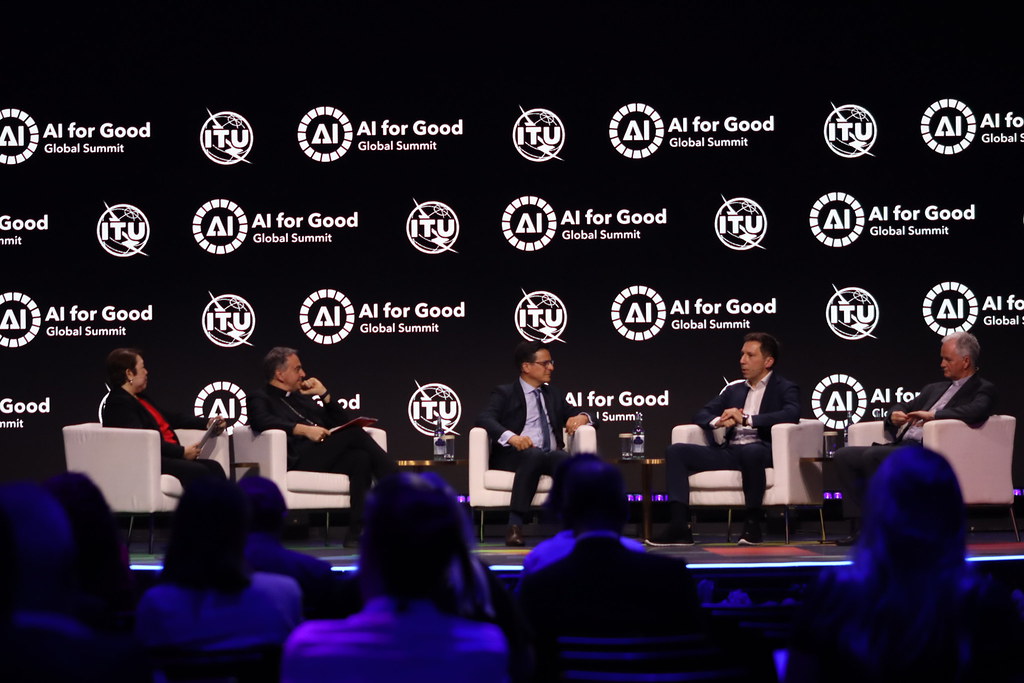
Geneva, July 2026 — Kluz Ventures Founder and CEO Artur Kluz joined senior representatives of the Holy See on Center Stage at the AI for Good Global Summit 2026 for a high-level conversation on Magnifica Humanitas: On Safeguarding the Human Person in the Time of Artificial Intelligence, the first Encyclical Letter of Pope Leo XIV.
The session took place on 8 July 2026 at Palexpo in Geneva during the AI for Good Global Summit, the United Nations’ leading platform on artificial intelligence, organized by the International Telecommunication Union (ITU) in partnership with other UN agencies and co-hosted by the Swiss Government. The conversation was convened by the Permanent Observer Mission of the Holy See to the United Nations and other International Organizations in Geneva, and brought together speakers representing the stakeholders consulted by the Holy See during the preparation of the Encyclical.
A Papal Message to the World’s AI Community
During the Summit’s opening ceremony, His Excellency Archbishop Ettore Balestrero, Permanent Observer of the Holy See in Geneva, delivered a message on behalf of Pope Leo XIV, signed by Cardinal Pietro Parolin, Secretary of State. As reported by the Holy See Mission, the message affirmed the Holy See’s openness to dialogue at what the Holy Father described as an epochal turning point, and recalled that Magnifica Humanitas grew out of the Pope’s listening to a wide range of stakeholders — including troubling accounts of the potential misuse of algorithms and the erosion of human agency in critical areas of life. It also renewed the Pope’s invitation to work together toward the common good and a dignified life for all.
The Conversation
Introduced by Ms. Nur Sulyna Abdullah, ITU’s Chief of Strategic Planning and Membership and Special Advisor to the Secretary-General, and moderated by Archbishop Balestrero, the panel featured:
Prof. Paolo Carozza, Co-Chair of Meta’s Oversight Board and Professor of Law and Political Science at the University of Notre Dame, who reflected on the role of ethics in AI development and what the Encyclical offers to academia and major technology companies seeking to align innovation with human dignity and freedom.
Artur Kluz, Founder and CEO of Kluz Ventures and Founder of the Kluz Prize for PeaceTech, who offered the perspective of an entrepreneur and investor working at the frontier of technology, exploring how the guidance of Pope Leo XIV can help preserve humanity in the era of artificial intelligence.
H.E. Msgr. Paul Tighe, Secretary of the Holy See’s Dicastery for Culture and Education and a member of the Holy See’s newly instituted Interdicasterial Commission on AI, who explained why the Church takes an active part in the global AI conversation, and noted that an Encyclical continues its journey as it is received and lived out in communities around the world.
Among those attending were members of the Delegation of the Vatican City State to the World Summit on the Information Society, led by Sr. Raffaella Petrini, President of the Governorate and of the Pontifical Commission for Vatican City State.
A Compass, Not a Constraint
Speaking around the Summit, Artur Kluz emphasized that the great achievement of Magnifica Humanitas is to shift the global AI conversation from the technology itself to the human person. In his view, the Encyclical offers entrepreneurs and investors a moral compass rather than a constraint: Pope Leo XIV does not oppose innovation or the responsible return on capital, but challenges builders to ask deeper questions about what they create, how, and why. Kluz argued that AI should expand human judgment rather than replace it, that it should be directed toward peace and humanitarian ends, and that moral formation must accompany technical formation — the core of the “Virtue Tech” concept he has developed.
These convictions animate the Kluz Prize for PeaceTech, one of the world’s leading initiatives dedicated to advancing AI and other technologies that serve humanity, build peace, and safeguard human dignity. Over the past four years, the Prize has attracted more than 350 applications from technology builders and innovators across 82 countries.
In her concluding remarks, Ms. Abdullah thanked the Holy See for its readiness to engage in the public discourse on artificial intelligence, underscoring that the safeguarding of human dignity and the common good must remain the criteria for judging whether technologies truly serve humanity.
Magnifica Humanitas, published on 15 May 2026 and marking the 135th anniversary of Rerum Novarum, appeals for the safeguarding of humanity, the promotion of truth, the dignity of work, social justice, and peace in the age of artificial intelligence. The full text is available on the Vatican website.